Preface
Guilin, located in the northeast of Guangxi, lies in the southwest of the "Hunan-Guangxi Corridor". Guilin is a well-known ecological city with beautiful landscape, a fascinating renowned international tourist city and one of the first famous cities of historical and cultural value at the national level
As early as 30, 000 years ago when the Guilin ancestors started to labor, live and reproduce offspring here, civilization emerged in the caves in the mountains. Since the setting up of Shi'an Xian (county) by Emperor Wu in the sixth year of the Yuanding Period (111 BC) of the Han Dynasty, Guilin has been a city with a history of 2120 years. Guilin was upgraded from Shi'an Xian to Shi'an Jun (prefecture) during the era of the Three Kingdoms, Gui Zhou (prefecture) in the Southern Dynasties, Jingjiang Fu (prefecture) in the Southern Song Dynasty and Guilin Fu in the early Ming Dynasty. In the third year of the Zhidao Period of the Northern Song Dynasty (997) , Lingnan was divided into two parts:Eastern Guangnan Lu (province) and Western Guangnan Lu (province) , and the office of the Jinglüe Anfushi (the official in charge of the local military and public security affairs) of the Western Guangnan Lu was set up in Guizhou. After that, with the fame of "the Prefecture of Conjunction in Southwest China", Guilin became the political, economic and cultural center of Guangxi and an important city of military operations in Southwest China till the early time of Republic of China (ROC in short, 1912-1949) . With such a long history, Guilin boasts plenty of cultural relics and historical sites everywhere.
In 1950 soon after the People's Republic of China was founded, many social elites, celebrities and experts in all circles in Guilin were invited to organize the first organ of relics protection—Guilin Committee for Cultural Relics Restoration and Protection. The professional organ of relics protection, Guilin Committee for the Cultural Relics Management, was officially set up in 1963. Nowadays, there are already 26 city-level and county-level departments of relics management and museums in the urban area and in the counties in Guilin.
Since 1950s, under the leadership of the People's Government of Guilin Municipality, several general surveys and investigations of the cultural relics and historical sites have been made around the city by the researchers. Among them, the three nationwide general surveys of cultural relics implemented in 1965, 1982 and 2008 have helped gain the basic data of all the relics in Guilin. Also, the special investigations of the prehistoric cave sites, the Lingqu Canal and the Site of Qincheng Castle of the Qin Dynasty, the cliff inscriptions/carvings in Guilin, the Tombs of Prince Jingjiang's family members and assistants, servants, etc., of the Ming Dynasty, the ancient folk houses and traditional buildings of ethnic groups, the ancient kiln sites and the relics of ancient transportation, etc., have been carried out systematically. Working together with the staff of the Institute of Archaeology of Chinese Academy of Social Sciences and the researchers of the Institute of Archaeology of Guangxi Zhuang Autonomous Region, the researchers of relics excavation and protection in Guilin have implemented some important relics excavations. Among them, the excavation of the tombs of the Warring States, the Han Dynasty and the Jin Dynasty on the Yinshan Mountain in Pingle County in 1974, with 165 tombs unearthed and 1044 relics found, has been the largest in scale in the history of archaeological excavation in Guilin. The excavation of the Baoji Cave Site in 1979, in which the tooth fossils of the late homo sapiens were unearthed, have helped trace the history of Guilin back to 30, 000 years ago. The two excavations of the Zengpiyan Site in 1973 and2001, which have established the development sequence of the prehistoric cave culture in South China, have won several national scientific research awards.
Based on the relics investigations and the archaeological excavations, 374 historical relics protection sites of different levels have been listed. Eleven sites of them, such as the Lingqu Canal in Xing'an County, the Palace of Prince Jingjiang and the Tombs of Prince Jingjiang's family members in Guilin, Li Zongren's former residence and official residence, the former Liaison Office of the Eighth Route Army in Guilin, the Zengpiyan Site, Guilin rock inscriptions, the Site of the Qincheng Castle in Xing'an County, the Yanwo Mansion in Quanzhou County, the Complex of Ancient Buildings in Jiangtou Village and Changgangling Village in Lingchuan County, the Complex of Ancient Buildings in Gongcheng County and the Sites of the Xiangjiang Battle have been listed as the national key relics protection sites. Besides, 72 sites have been listed as the cultural relics protection sites of Guangxi Zhuang Autonomous Region and 291 have been listed as the city-level and county-level cultural relics protection sites. These sites, which vividly reflect the situations of the social and economic development of Guilin in different periods of history, are the precious cultural heritage of Guilin, a renowned historical and cultural city.
The relics in Guilin, with distinct features of the times and significant geographical characteristics, possess very high historical, artistic and scientific values. The data of the excavations show that, with as many as over ten caves related to the ancient people's activities, Guilin is one of the areas with the richest prehistoric cave relics in China and even in the world. The Baojiyan Site, the earliest relics site in Guilin, has a history of over 30, 000years. With so many excavated relics, so peculiar cultural features and such a long history, the Zengpiyan Site has played an important role in the excavation of the Chinese Neolithic Age and has been the best-preserved cave of the Neolithic Age in China with the most plentiful relics and highest in altitude. The 4, 000-year-old carbonized rice grains unearthed in the Xiaojin Site in Ziyuan County, greatest in number and highest in altitude, have been considered the earliest rice grown in Lingnan area of China. The Lingqu Canal, built in the thirty-third year of the Qin Shi Huang (the first emperor of the Qin Dynasty in China) Period of the Qin Dynasty (214 BC) , played a very important role in helping Qin Shi Huang unify China. The Lingqu Canal, connecting two rivers, the Xiangjiang River and the Lijiang River, thus linking the Yangtze River and the Pearl River, has been an important waterway between the Central Plains and the Lingnan area for 2, 000 years. It has played a very important role inthe economic and cultural communication and development of the two regions and has also created favorable conditions for the breeding and development of the history and the culture of Guilin. In the sixth year of the Yuanding Period of Emperor Wu of the Han Dynasty, the setting up of Shi'an County/Shi'an Xian was the start of the founding of Guilin City. The period between the Han Dynasty and the Southern Dynasties was the time of systematic establishment and rapid development of Guilin and its governing counties as well as the time of the fast economic and social development, which has been strongly supported by the city site, tombs and the unearthed relics of that time. Gui-Liu Canal (Guilin-Liuzhou Canal or Xiangsidai Canal) , connecting the Lijiang River and the Liujiang River, was built in the Tang Dynasty. As a link of Guangxi, Yunnan and Guizhou, this vital waterway between the Central Plains and the Southwest played an important role in the economic and cultural communication and development of these two areas. With endless streams of worshipers, the large-scale Xiangshan Temple, built in Quanzhou County during the Tang Dynasty, was thencalled "the No. 1 Temple in Chu'nan (Hunan Province) ". The Miaoming Pagoda, the Fish-releasing Pool, the Emperor Kangxi's inscription and the inscription of the orchids drawn by Shi Tao (a famous Chinese painter of the Qing Dynasty) , are still found there in the ruins ofthe temple. The typical Karst landform provides wonderful media for recording the history and the culture of Guilin. On the cliffs or in the caves of over 30 famous mountains there are about 2000 inscriptions and statues, which make up the wonder of "the Rock Carvings and Cliff Inscriptions Existing Everywhere in the Mountains". With the fame of "Taking a look at the mountains being like appreciating a picture and visiting the mountains being like learning the history", Guilin has become the most concentrated and the most typical place of the rock carvings and cliff inscriptions of the Song Dynasty in China. The perfect integration of the cliff inscriptions and the beautiful landscape in Guilin has formed the unique natural and cultural scenery in the world. The City Map of the Jingjiang Fu (Prefecture) , engraved on the cliff of the Yingwu Hill (the Parrot Hill) in the Song Dynasty, is the largest cliff inscription of the ancient city map ever preserved in China. The moats, the military camps and the official buildings, the bridges and the ferries, the mountains and the rivers as well as the main streets in the map can be proved by the relics site of the Jingjiang Fu in Guilin. The Chinese characters“桂林山水甲天下” (Guilin's scenery is the best in the world) composed by Wang Zhenggong and engraved on the cliff of the Duxiu Peak (Solitary Beauty Peak) are the best words praising the beautiful scenery of Guilin for the first time. The rock inscription of the Chinese character“壽” (longevity in English) , which is composed of more than 100 Chinese characters“壽”of different sizes and in different fonts in the Baishou Cave in Baishou Town, Yongfu County, possesses a great artistic value. The rock inscription of the Chinese character“帶” (belt in English) on the cliff of the Bilian Peak (Green Lotus Peak) , west of the Lijiang River and near the county town of Yangshuo, looks vigorous and graceful. With the peculiar structure and rich connotations, the Chinese character“帶”, is one word in cursive script at first glance but is really a wonderful rock inscription with rich connotations at a second glance. In the third year of the Hongwu Period of the Ming Dynasty (1370) , Zhu Shouqian, the grandnephew of Zhu Yuanzhang (the first emperor of the Ming Dynasty) , was conferred the title of Prince Jingjiang governing Guilin. The palace which was built at the foot of theDuxiu Peak two years later where the Longevity Palace, the former residence of Emperor Shun of the Yuan Dynasty was located, is the best-preserved princely palace of the Ming Dynasty with the most special shape and style. This palace was turned into Guangxi Examination Hall in the Qing Dynasty. The Chinese characters“三元及第” (being No. 1 inall the three stages of the imperial examinations) , “狀元及第” (being No. 1 in the palace examination) , “榜眼及第” (being No. 2 in the palace examination) engraved on the stone archways of the Imperial City have verified the history and the prosperity of the education in Guilin since the Qing Dynasty. The tomb complex of Prince Jingjiang's family members, etc., covering an area of 100 km2, is the most complete tomb complex of the seigniors of the Ming Dynasty, with the fame of"the No.1 tomb complex in the Lingnan area". Guilin is the only place all over China where the imperial palace and the imperial tombs of the Ming Dynasty are well preserved. The city of Yongning Zhou (prefecture) in Baishou Town of Yongfu County is the best-preserved town of the Ming Dynasty in Guangxi. The Yanwo (the birds' nest) Hall in Shigang Village, Quanzhou County is famous for the birds' nest-like array of brackets on the gate tower of the ancestral hall. As the column-and-tie structure and the post-and-lintel structure are used together with mortise and tenon joints, this tower is a combination of the building styles of the Ming and Qing dynasties. The Confucius Temple in the county town of Gongcheng, largest in scale and longest in history, is the best preserved temple in Guangxi at present. The fact that the Wu Temple (the temple dedicated to Guan Yu, the symbol of loyalty, brotherhood and bravery) is only 50 meters away from the Confucius Temple is rarely seen all over China. Besides, there are ancient buildings with the styles of the Ming and Qing dynasties, such as the folk houses in Jiangtou Village and Changgangling Village of Lingchuan County, in Shuiyuantou Village of Xing'an County, in Yueling Village of Guanyang County, in Langshan Village of Gongcheng County and in Jingtou Village of Ziyuan County, the Yuedong Guild Hall in Pingle County, the Pagoda in Lipu County and the drum towers in Pingdeng Village of Longsheng County. These buildings, scattering in Northern Guangxi like raw gems, present the beauty of each other with Guilin, a pearl-like splendid city with a rich culture and a long history. During the period of the Republic of China (ROC, 1912-1949) , Sun Yat-sen set up the presidential field headquarter and the base camp of the Northern Expedition in Guilin. Soon after that, the rise of the new Guangxi clique headed by Li Zongren, Bai Chongxi, etc played a significant role in the history of the Republic of China (1912-1949) . The former private and official residences of those military leaders can still be found in Guilin.
The Red Army passed Northern Guangxi during their Long March in 1934. During that time they fought the fiercest life-and-death battles against the Kuomintang (KMT) Army along the Xiangjiang River with the greatest damage, leaving harsh revolutionary footprints there. During the War of Resistance Against Japanese Aggression, the Guilin Liaison Office of the Eighth Route Army was set up by the Communist Party of China. Also in this period, hundreds and thousands of Chinese cultural celebrities gathered in Guilin. They implemented a grand cultural movement against the Japanese aggression, thus making Guilin a famous nationwide cultural city against the Japanese aggression. Guangxi Provincial Art Gallery, which won the fame of "the No. 1 grand drama building"in the rear area during the War, became the landmark of Guilin, since the first Southwest Drama Exhibition, a grand cultural act fighting against the invasion was held in it.
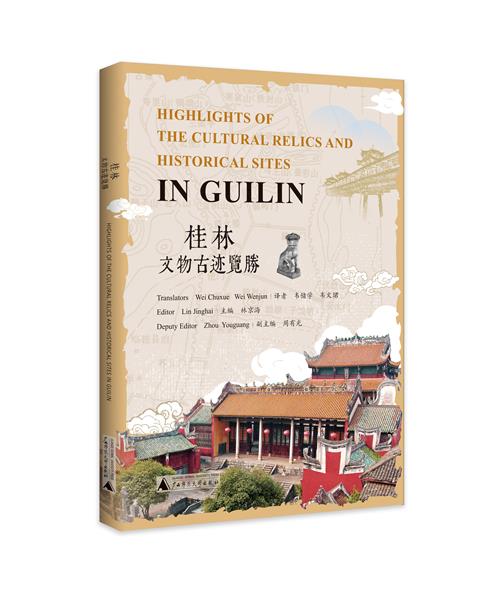
The book Highlights of the Cultural Relics and Historical Sites of Guilin was compiled by the Office of Guilin Committee for Cultural Relics Management with the purpose of enhancing the protection, research and publicity of Guilin's historical and cultural relics which are beneficial to the social and economic development of Guilin. With detailed and accurate materials and descriptions, this book, aiming to introduce the cultural relics and historical sites of all levels in Guilin, and their adequate historical background information and cultural connotations, is informative and readable. The publication of this book will help the Guilin natives and the tourists both at home and abroad have a deeper understanding of the history and the culture of Guilin so as to arouse their enthusiasm of loving, protecting and constructing Guilin. May Guilin—a beautiful city with a long history, have a brighter future.
The Compilation Committee